Battery
The Kompakt keeps its own charge history, and KompaktOS shows it. Kompakt app → Settings → Battery.
Charge limit
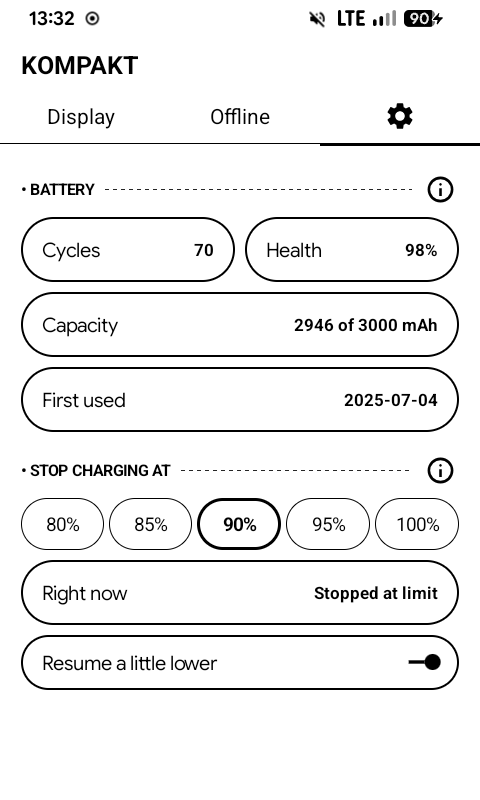
Pick a level between 80 and 100. Charging stops there and resumes a little below it.
A charge limit can only stop charging. It will not bring a battery that is already at 100% back down, so nothing appears to happen until the level falls below the resume point and charges again. The Right now row on the same page tells you what the charger is actually doing:
| Row says | Meaning |
|---|---|
| Stopped at limit | Plugged in, charging held |
| Charging | Plugged in, charging |
| Full | At 100% |
| Not plugged in | On battery |
Keeping the limit under 100 is the single most effective thing you can do for how long the pack lasts over years.
Cycles, capacity and health
- Cycles — full-charge equivalents, counted by the vendor firmware. Not a count of how many times you plugged in.
- Capacity — what the gauge believes the pack holds now, against its nominal 3000 mAh.
- First used — stamped once, on first boot.
The cycle count also appears in Android's own Settings → Battery → Battery information.
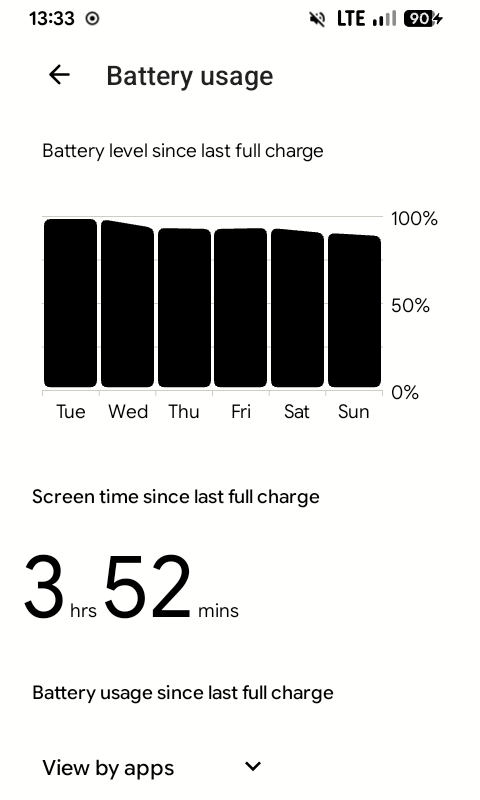
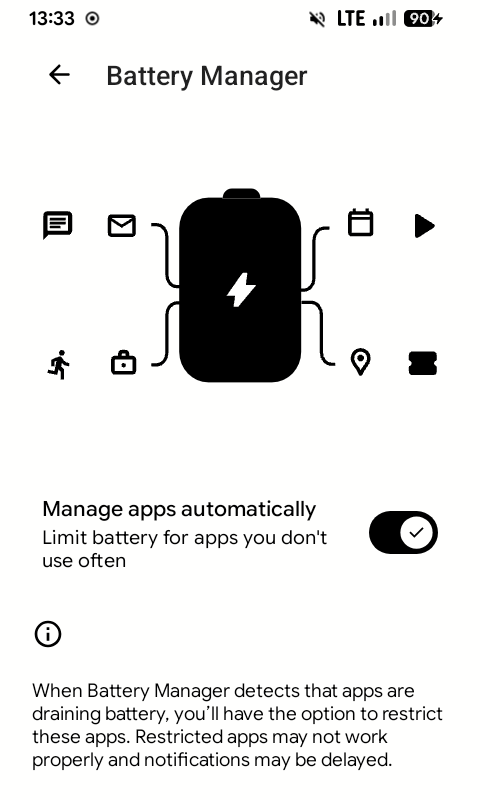
Android's own battery screens work as usual: Battery usage shows the level and screen time since the last full charge, and Battery Manager limits apps you rarely use.
Where the history lives. Cycles and the first-use date are kept on a separate partition of the phone, not by Android, which is why they survive reinstalling the OS — including going back to MuditaOS and returning.
Capacity figures, honestly
Android reports capacity from a fuel-gauge table rather than by measuring the cell, and that table does not change as the battery ages. The health percentage derived from it is therefore stable rather than meaningful. Treat the cycle count as the real indicator of wear.